Dinah Singleton's disappearance and secret imprisonment
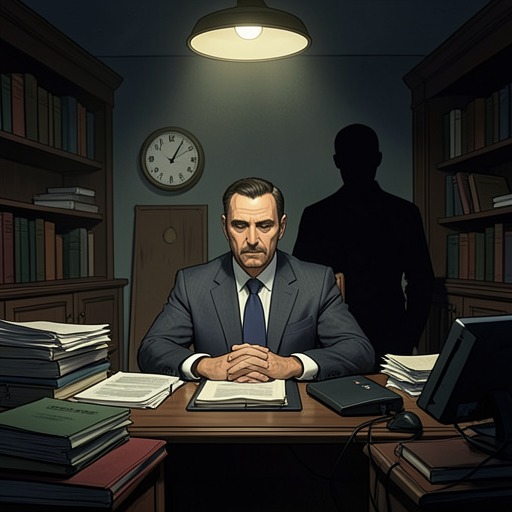
Down Cemetery RoadDinah Singleton’s disappearance is revealed not as an absence but as a secret confinement: the four-year-old is found in a former cell, under the care of a nurse, while the people responsible for her custody offer no intelligible account of why she is there. Amos Crane’s awkward visit with a teddy bear briefly gives the child an object of comfort, but it cannot disguise the room’s former purpose or the secrecy governing her presence. Later, Joe Silvermann’s letter to Sarah links the search for Dinah to a discrepancy in the official story of her father’s death, widening the mystery beyond the child’s immediate imprisonment.
Discovery in the former cell
Amos Crane learns that Dinah is downstairs with the child, leaves the others discussing his odd behavior, and passes a cat on the stairs. The cat darts by as though it recognizes him. He finds Dinah with a nurse in one of the building’s former cells. Faced with a four-year-old, he cannot think how to begin a conversation; then he remembers the bear and offers it to her. Dinah looks at him with wide eyes. The small gift is an attempt at contact, but the scene makes no suggestion that it can undo what she has experienced.
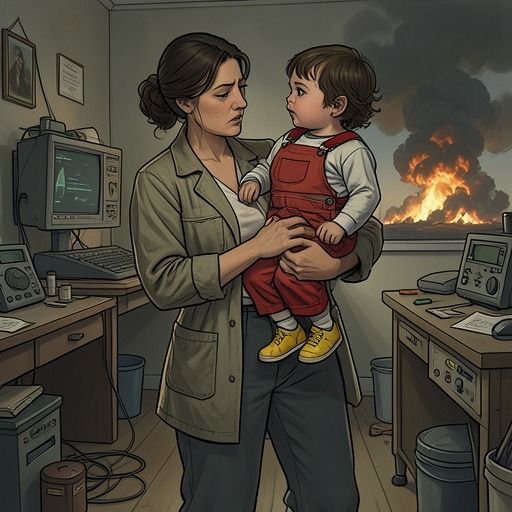
The nurse, Deedee, is about forty and described as battle-scarred. She holds Dinah close, and the child clutches her knee. Amos briefly wonders what brought Deedee to the job, in a place with only two men and no worthwhile television channels; Dinah’s attachment to her suggests that the nurse’s importance is not merely practical. Deedee and Dinah sound to Amos like the names of characters in a sitcom, a fleetingly ordinary association set against an unmistakably abnormal arrangement: a small child and her caregiver housed in a cell.
A nursery made inside a cell
The room has been adapted for Dinah, but the conversion is visibly incomplete. Paint has been splashed around the walls at a child’s height, as if to give her a four-year-old’s version of decoration, and the duvet bears cartoon lions. Yet there are no windows, and the walls still ripple where the drills failed to cut them smooth. The details establish both care and confinement: someone has tried to make the room more suitable for a child, but its physical structure continues to declare what it was built to be. It is not a nursery so much as a cell with a few nursery objects placed inside it.
Deedee asks whether Amos has come to take Dinah away. He says no, and Deedee insists that wherever the child goes, she will go too. When she asks why Dinah is there, Amos answers only that it is because of circumstances. Deedee says that none of them have been told anything. Amos replies that none of them need to know, then asks how long she has been with them. The exchange exposes an information barrier inside the operation itself: even the person caring for Dinah is excluded from the explanation. Amos’s outward reassurance that he has brought only a bear sits beside his unspoken threat that Deedee will do what she is told. His visit offers a moment of apparent gentleness, but it does not alter his authority over the child’s situation.
Care, knowledge, and withheld explanation
When Deedee asks whether Amos understands what Dinah has been through, he considers the question and recognizes that the honest answer is yes. He also decides not to say so. Instead, he puts the bear on the floor about a foot in front of Dinah and steps back, looking around the cell. His silence is not evidence that he knows nothing; the narration expressly presents it as a choice not to disclose what he understands. The scene therefore distinguishes knowledge from explanation: Amos can recognize the child’s suffering while still participating in an arrangement that keeps her confined and keeps its reasons from the nurse.
Dinah’s position is rendered through gestures and surroundings rather than a full account of how she came to be there. She clutches Deedee’s knee, and the bear is left within reach rather than pressed into her hands. The room’s child-height paint and cartoon bedding indicate attempts to accommodate her, while the barred-feeling absence of windows and unfinished drill marks preserve the cell’s oppressive reality. The contrast does not resolve whether those caring for Dinah can protect her; instead, it shows how limited care operates inside a setting controlled by secrecy.
The search and the official account
In a later letter to Sarah, Joe Silvermann acknowledges that she is right to keep looking for the little girl, apologizes for having become angry, and says he will help, even if the search takes them to Surrey. He proposes beginning with an apparent contradiction in the Ministry of Defence’s public account: its press release said Thomas Singleton had died four years earlier, yet he had reportedly died again more recently. Joe asks whether the Ministry knows about the discrepancy and argues that it is well placed to find answers. The letter does not establish what officials know, but it makes the conflict between the dates a concrete lead rather than a vague suspicion.
Joe further argues that wherever the answer to Thomas Singleton’s death lies, Dinah will be found there too. His reasoning binds the child’s disappearance to the unresolved fate of her father and gives Sarah’s search a wider institutional dimension. The letter’s proposal to seek discreet answers, partly to avoid greater press attention, also contrasts with the silence surrounding Dinah in the cell: in both settings, access to information is controlled, but Joe’s letter turns that control into something Sarah can investigate. Together, the confined child and the conflicting death reports make the disappearance more than a missing-person mystery. It is evidence of a concealed situation whose explanation has been withheld even from the people charged with caring for her.